Canvas
Contact:
Canvas Quizzes
Useful resources:
Two types of quizzes:
- 🔥 Assignment Quizzes: show in grade book, can be graded, and students can see their results
- Speed Grader is enabled; can give feedback to individual students through submission comments; students can also send messages; → Easy to jump btw students; support rich text comments (equations).
- Students can send messages through comments. → Allow communication between students and graders.
- Practice Quizzes
- Not shown in grade book by design. But you can still grade them.
- Can see Quiz Statistics and Moderate This Quiz. → Hard to navigate btw students; support only plain text comments. → Not convenient to give feedback.
- Students cannot send messages through comments. → One-way communication from graders to students.
Q: What’s the differences between New Quizzes and Classic Quizzes?
A: New Quizzes is supposed to have more features, such as screen calculator, but it is still in beta. You need to configure settings for each question… And it takes forever to load (it re-builds every time you open it). → Need some patience with New Quizzes; in exchange for better integration with Item Banks, Stimulus question type.
New Quizzes are the trend anyways, so start using it now. It will support more features and be more robust in the future as it is under development. By contrast, Classic Quizzes are stable but will be deprecated in the future.
Same logic everywhere. It’s a trouble to migrate from an old version you are used to to a new version. You need to spend time to learn the new version, but it is worth it in the long run. 👍
Q: What good is New Quizzes?
-
For multiple choice questions, the correct answer can be set to any options, not just the first option as in Classic Quizzes.
-
Support Stimulus question type (a passage followed by multiple questions).
More question types are supported in New Quizzes.
-
Can shuffle questions whereas Classic Quizzes only support shuffle answers. → NOT a practical function to use; I want to fix the order of questions in my quizzes anyways. Just more organized that way.
-
Only New Quizzes support the option “Do not count this assignment towards the final grade.” → In Classic Quizzes, you choose “Practice Quiz” to achieve the same effect.
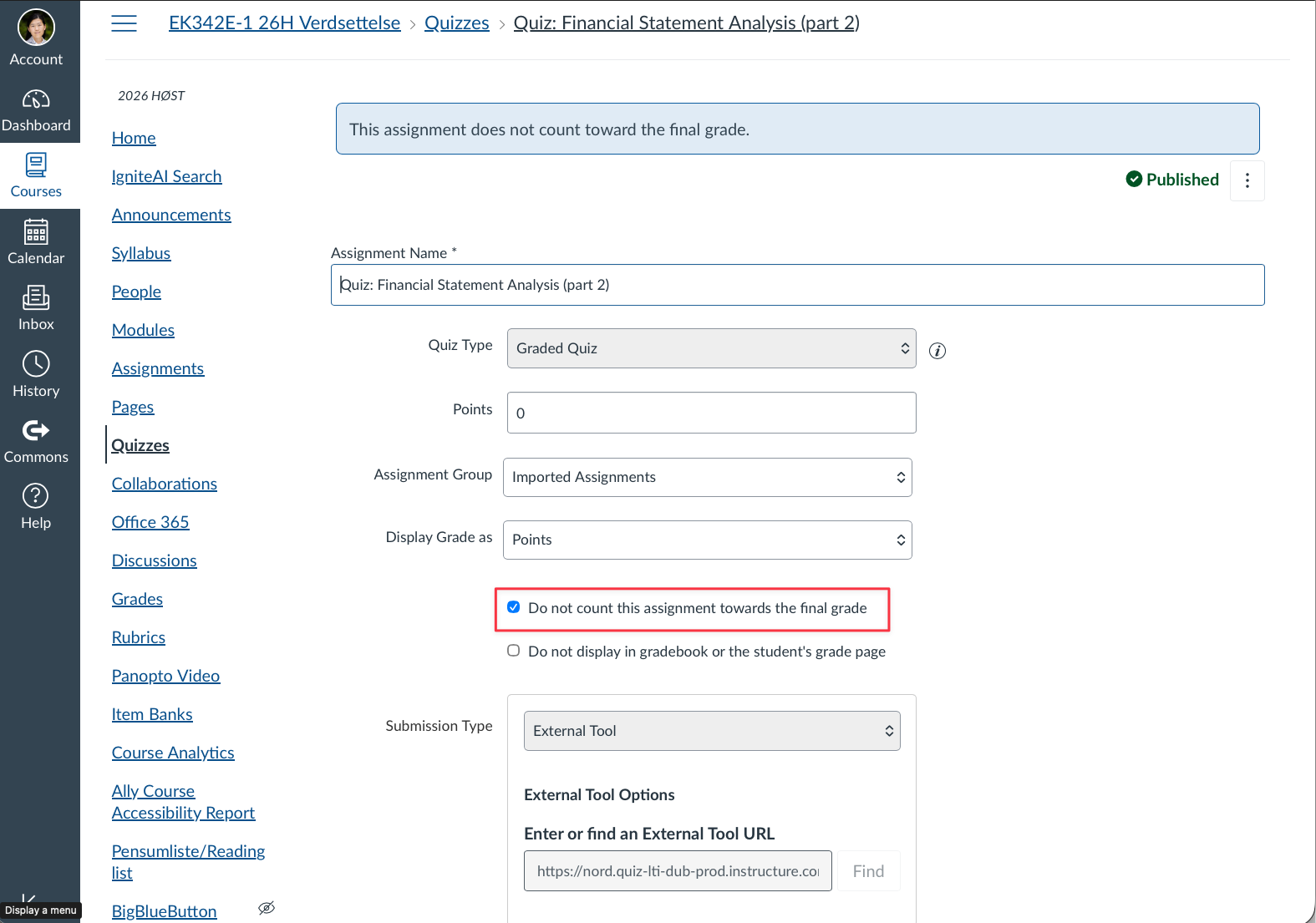
See HERE for a side-by-side comparison of Classic and New Quiz features.
Q: I set Classic Quizzes as my default quiz type, how can I create a New Quiz type now?
A: Need to reset Quiz Engine Choice. Click on the Quiz Settings menu button (three vertical dots) in the top right, then select “Reset Quiz Engine Choice”.

Some nice options to tick:
Use Classic Quizzes as an example. The same options are available in New Quizzes.
-
Always tick shuffle answers when you use Classic Quizzes. → Not necessary for New Quizzes.
Otherwise, for multiple choice questions, the correct answer always show as the first choice.
-
Tick “Allow Multiple Attempts”.
This allows students to take the quiz multiple times.
-
Show all questions at one.
Leave the options “Show one question at a time” unticked.
-
Write an instruction at the beginning in case students wonder if the quiz counts into the final grade.
There is one option "Do not count this assignment towards the final grade" in New Quizzes. So you don't have to write an instruction in New Quizzes. But in Classic Quizzes, you need to write an instruction to tell students that the quiz is for practice only.Instructions
Note: Quizzes do NOT count toward the final grade. They are designed to help you understand the material and prepare for the exam and homework.
Question Banks
Question Banks are re-named as “Item Banks” in New Quizzes.
Use Item Banks to mange quizzes, they are available across courses. So you don’t need to copy quizzes from one course to another. You can just add questions from the Item Banks to your quizzes.
Q: Is it worth it to use Item Banks?
A: For me, it might be easier just to copy the quizzes from one course to another. I have full control of the order of questions in quizzes. The quizzes don not change much from year to year.
Q: When Item Banks can be useful?
A: When you have a large number of questions and want to randomize them in quizzes.
A common scenario is that you have a quiz and you want to add it to an Item Bank.
-
Export the quiz as a QTI ZIP file.
Settings > Export Course Content
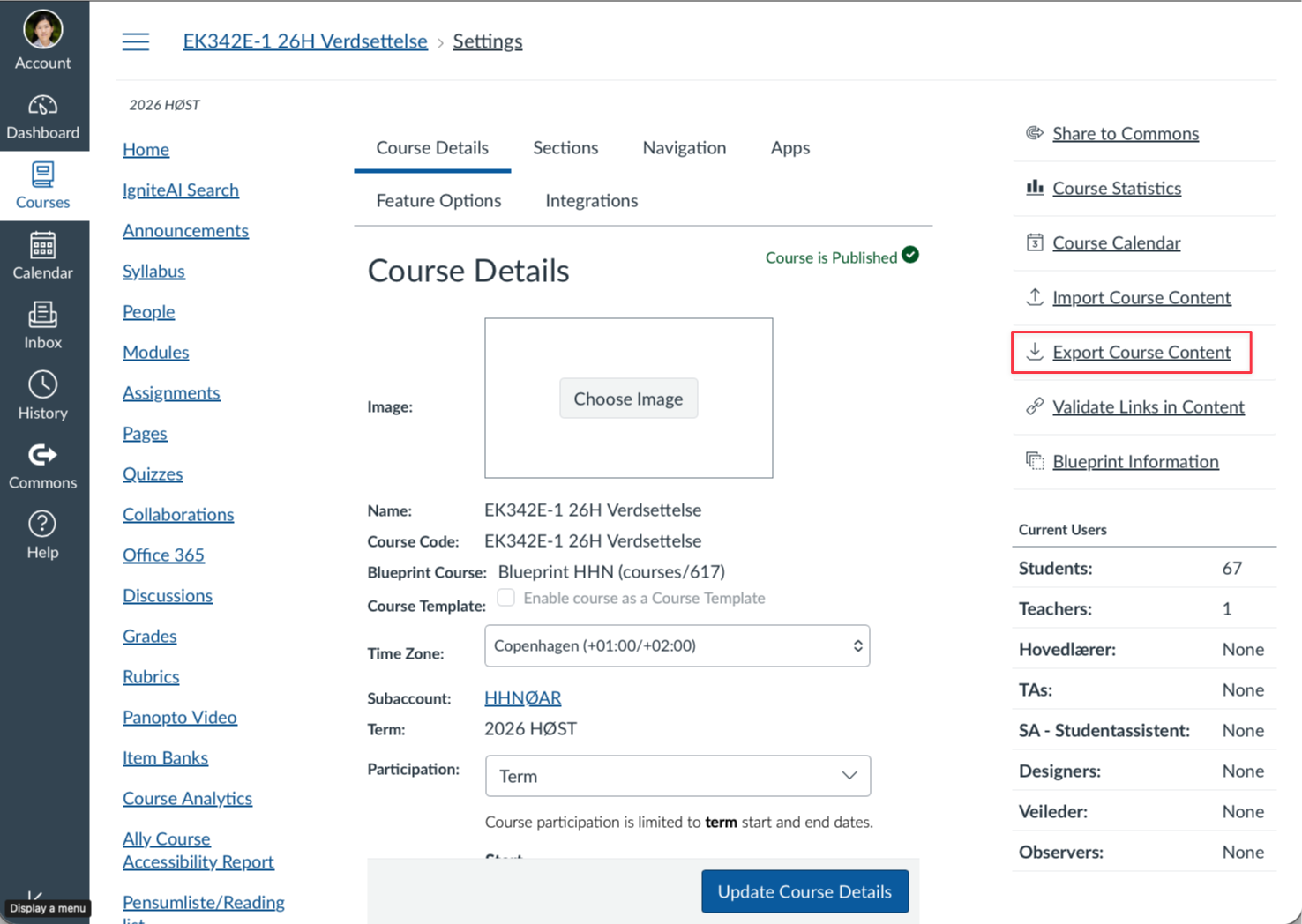
Choose “Quiz” in Export Type > Select the Quizzes you want to export > Click “Create Export”
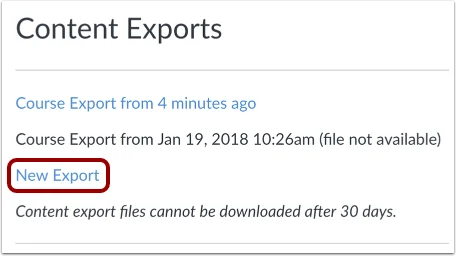
When the export is done, click “New Export” link to download the QTI ZIP file.
-
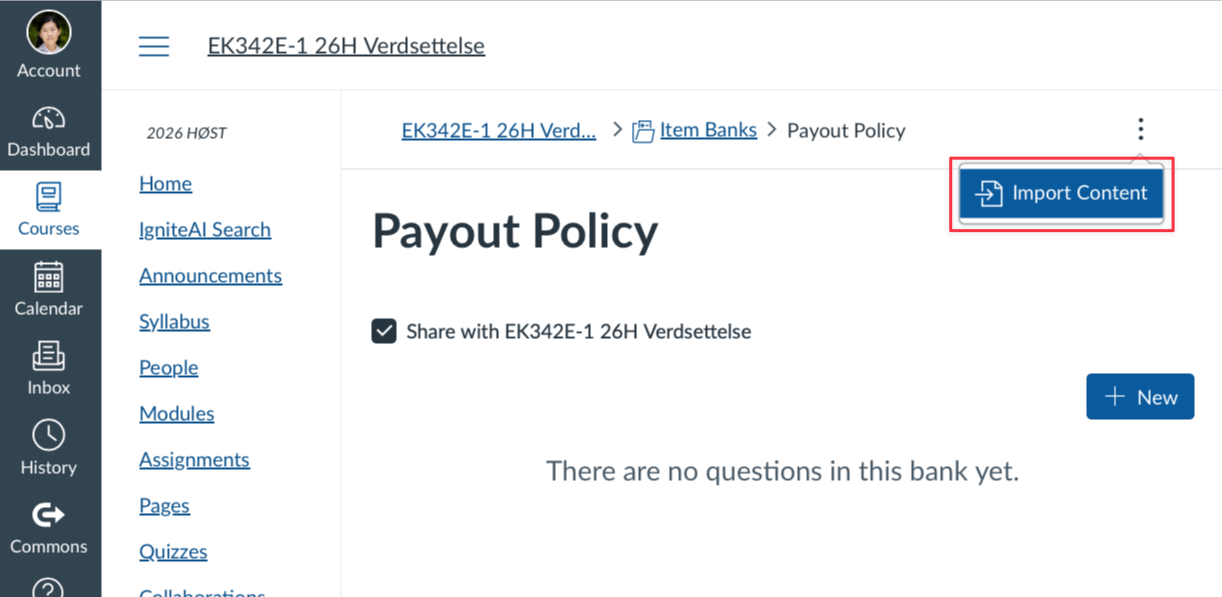
Import the QTI ZIP file into an Item Bank.
-
Add the questions from the Item Bank to your quiz.
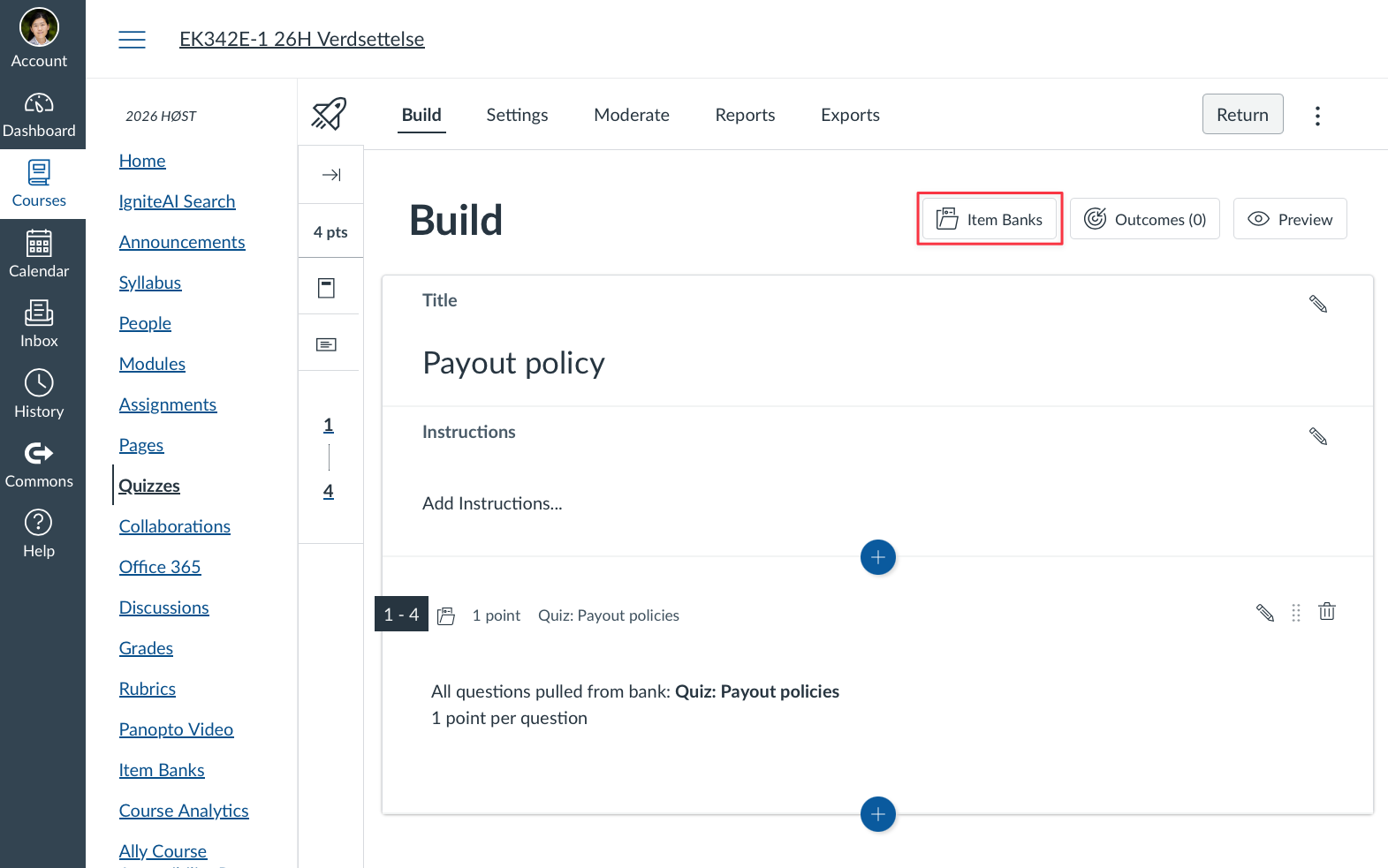
Q: I have two sub-quizzes, I want to combine them into one quiz and add them to an Item Bank. How can I do that?
A: Following the steps below:
- Export the two quizzes as QTI packages. See export-quiz.
-
Import the QTI ZIP back into the course content.
Go to “Settings” > “Import Course Content” > From the “Content Type” dropdown, select .QTI Zip File and select the ZIP file > Click “Import”.
Now the two quizzes can be searchable when you create a new quiz.
-
Combine the two quizzes into one quiz.
Create a new quiz, then go to “Questions” tab > Click “Find Questions” > Select the two quizzes you just imported > Click “Add Questions”.
-
Add the new combined quiz to an Item Bank.
- Export the new combined quiz as a QTI ZIP file.
- Import the QTI ZIP file into the Item Bank.
Go to "Item Banks" > Click the three dots...at the top > Click "Import Content" > Select the QTI ZIP file of the combined quiz > Click "Import".
You cannot load two sub-quizzes using the QTI ZIP file in step 1 directly into an Item Bank. Only the first quiz will be imported and the item bank will be re-named as the first quiz’s name.
So you have to first combine the two quizzes into one quiz, then import the combined quiz into an Item Bank.
ref: How to Combine Classic Quizzes in Canvas
Add questions to Quizzes from Item Banks
-
Add specific questions from an item bank
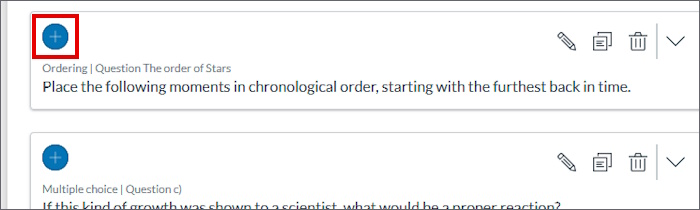
-
Add all questions from an item bank
Press the “+All/Random” button, then choose “Use all questions”.
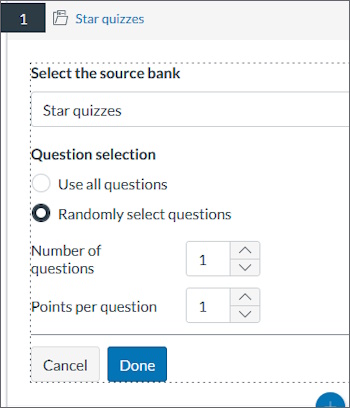
-
Randomize a certain number of questions
Choose “Randomly select questions”.
Set how many questions you want to be randomly selected from the item bank. Both the order and the questions used will be different for each student. This is when New Quizzes are useful as it support Stimulus question type (a passage followed by multiple questions).
ref: Add or randomize questions from a New Quiz item bank
Q: How to create a Question Bank?
A: In the left sidebar, click “Item Banks”, then click “+ Item Bank” to create a new bank.

Q: How to import questions from a QTI package into an item bank?
A: First export quiz content as a QTI ZIP file. Then go the the Item Bank page, click the three dots ... at the top, click “Import Content”. Note: if there are questions in your item bank already, you won’t be able to select the Import Content option.
Q: How to export Quizzes as QTI package?
A: In the Course Navigation sidabar, click “Settings” > “Export Course Content” > Select “Quiz” > Choose the specific quiz(zes) > Click “Create Export”. The export process starts, when it’s done, you can click the file to download the QTI ZIP file.

Q: What is a Question Group?
A: A Question Group is a collection of questions that can be added to a quiz. When a Question Group is added to a quiz, a specified number of questions are randomly selected from the group for each student taking the quiz. This allows for greater variability in the questions presented to each student, which can help reduce cheating and improve assessment reliability.
If you need your questions to appear in a specific order, do NOT use Question Groups.
refs:
Tables in Canvas
Two options:
-
edit in Excel, use html table generator, paste html code to canvas, and format as you like [time consuming, but best visual effect, clear and neat]
table $\rightarrow$ code: https://wordhtml.com
table $\leftrightarrow$ code: https://divtable.com/generator/
-
edit in Excel, paste as picture, then save and add the table as picture. [quick but rather blurry]
Edit math equations on Canvas
Tips:
-
Short symbols: Use
\(...\)for inline equations and$$...$$for block equations. The equations won’t be displayed live. When your focus is moved out of the text field, your LaTeX code will be rendered. -
Complex formulas: Select ‘Directly Edit LaTeX’ in the Maths Editor to create complex equations. A preview of what will be displayed is shown underneath the LaTeX code.
A nice Tutorial how to edit latex on Canvas
-
Type the appropriate Delimiter to signal that the equation should be rendered in LaTeX.
-
\(and\)should be used for equations that are meant to be displayed inline with text.When edit quiz questions, use
\(...\)as delimiters in LaTex. This saves time when you copy and paste from LaTex to Canvas. -
$$should be used for equations that are meant to be displayed in separate blocks.
-
-
Type the Equation between the delimiters.
- Ex:
\(2+2=4\)for inline text or$$2+2=4$$for block text
- Ex:
-
Click Save for whatever text field you are working in.
The text field won’t render the eqn. immediately for you. Only after you exit the text field and preview the question, the eqn will show up properly.
-
Check that the Equation is being displayed correctly.
Can also insert a file/image into the field box.
https://support.inspera.com/hc/en-us/articles/360043210312-Insert-file-in-questions
Add images
Use the following codes. Need to number the figures manually.
<figure><img style="display: block; margin-right: auto; margin-left: auto; zoom: 20%;" src="/courses/29234/files/1639589/preview" alt="Boxplot for the two groups." />
    <figcaption>Fig. 1 Boxplot for the two groups.<br /><br /></figcaption>
</figure>
Assignment
Setting up different due dates for one assignment
-
Select Assignment
-
Add due date.
-
Choose file type to limit to pdf submissions. Easier for grading.
-
It is possible to choose a date for which after that date students cannot submit again. → Set “Until”. Note that Due date is the date that the assignment is due. After that date, students can still submit but it will be marked as late.
SpeedGrader
Filter students who have submitted:
By default, SpeedGrader shows all students alphabetically. But you can filter the list to show only students who have submitted the assignment.
Click the gear botton ⚙️ > Sort student list dropdown menu > Choose “by Submission Status”
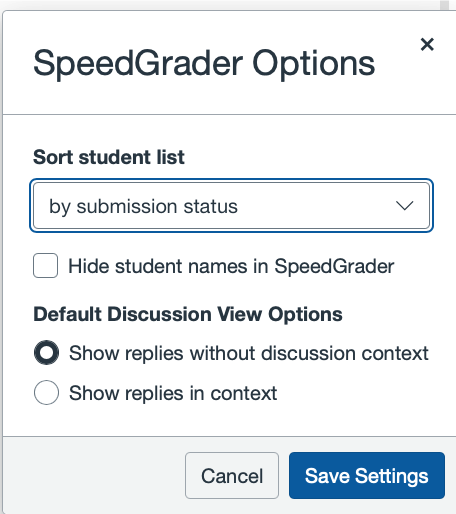
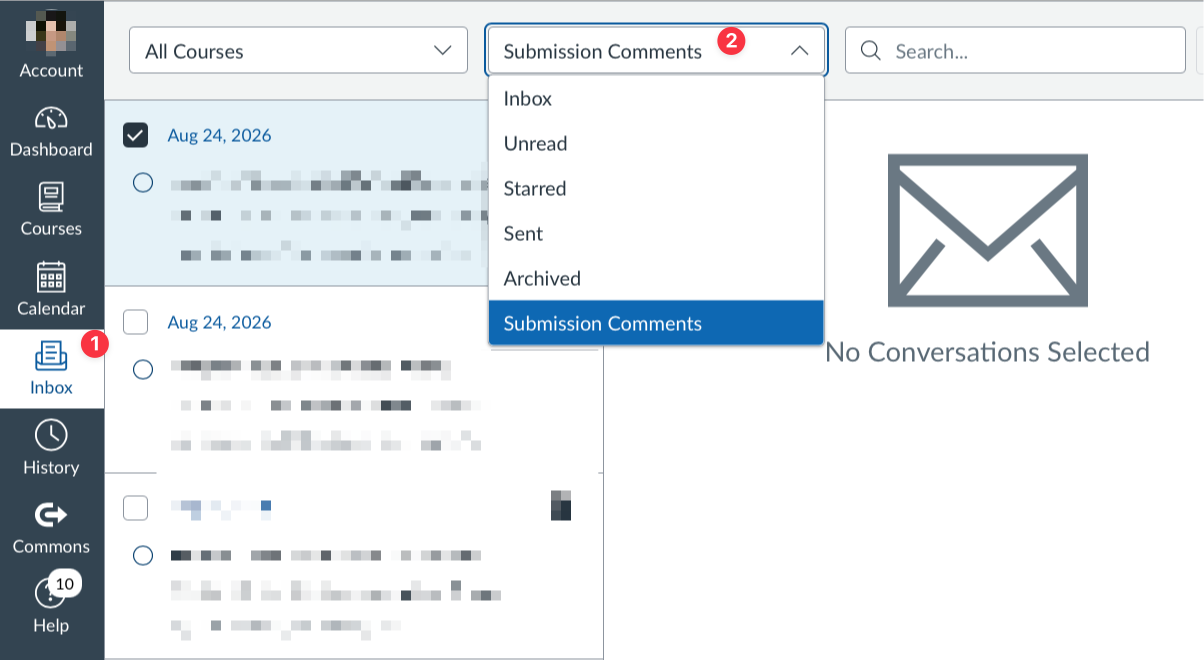
Q: How to see students’ submission comments?
A: Inbox > Choose “Submission Comments” in the dropdown menu.
Files
When replacing a file in Canvas, first change the name of the new file to be exactly the same as the old file. Then upload the new file. This way, the old file will be replaced and all links to the old file will still work.
- Otherwise, you will have to delete the old file and then re-add the new files to the corresponding modules.
- The display name under modules will stay the same as the old file name. The display name points to files. When you replace a file, the display name will not change.
Q: What is the difference between display name and file name?
A: Display name is for indicating the content of the file. It can be any name you want as it is only a text field. File name, on the other hand, is the actual name of the file; cannot contain special characters like :.
- You don’t have to change the file name when uploading a file. Just change the display name. This way, you can keep the file name consistent with your local version, and you can replace it without changing the file name.
Q: How to specify the visibility time for a file?
A: Schedule visibility.
Go to Files, Click the three dots next to the file you want to schedule (Under Actions column), then click “Edit Permissions”, Under Available, choose “Schedule availability”.

Then you can add the file to corresponding module. The file will only be visible during the scheduled time.
ref: How do I restrict files and folders?